TB-4861 · REV A · Technical newsheet
Test & MeasurementDevice profile
Emerson's Nigel AI Writes LabVIEW Code From a Prompt
Emerson's custom-built Nigel AI generates LabVIEW code and test sequences from a prompt, with direct access to product documentation. Vendor claims, so far, without published benchmarks.
By Amara Osei4 min read736 words
Features
- Emerson's Nigel AI generates LabVIEW code and test sequences from a prompt, the company says
- Nigel has direct access to product documentation and project context, so answers aren't generic, per Emerson
- Rudy Sengupta, Senior VP and CTO at Emerson (formerly NI), discussed the tool in a podcast with Alix Paultre of Electronic Design
- Sengupta has almost two decades of experience at NI across engineering, product management, and strategy
- The podcast covers code generation at 02:08, test engineering challenges at 03:15, and a comprehensive AI approach at 07:29
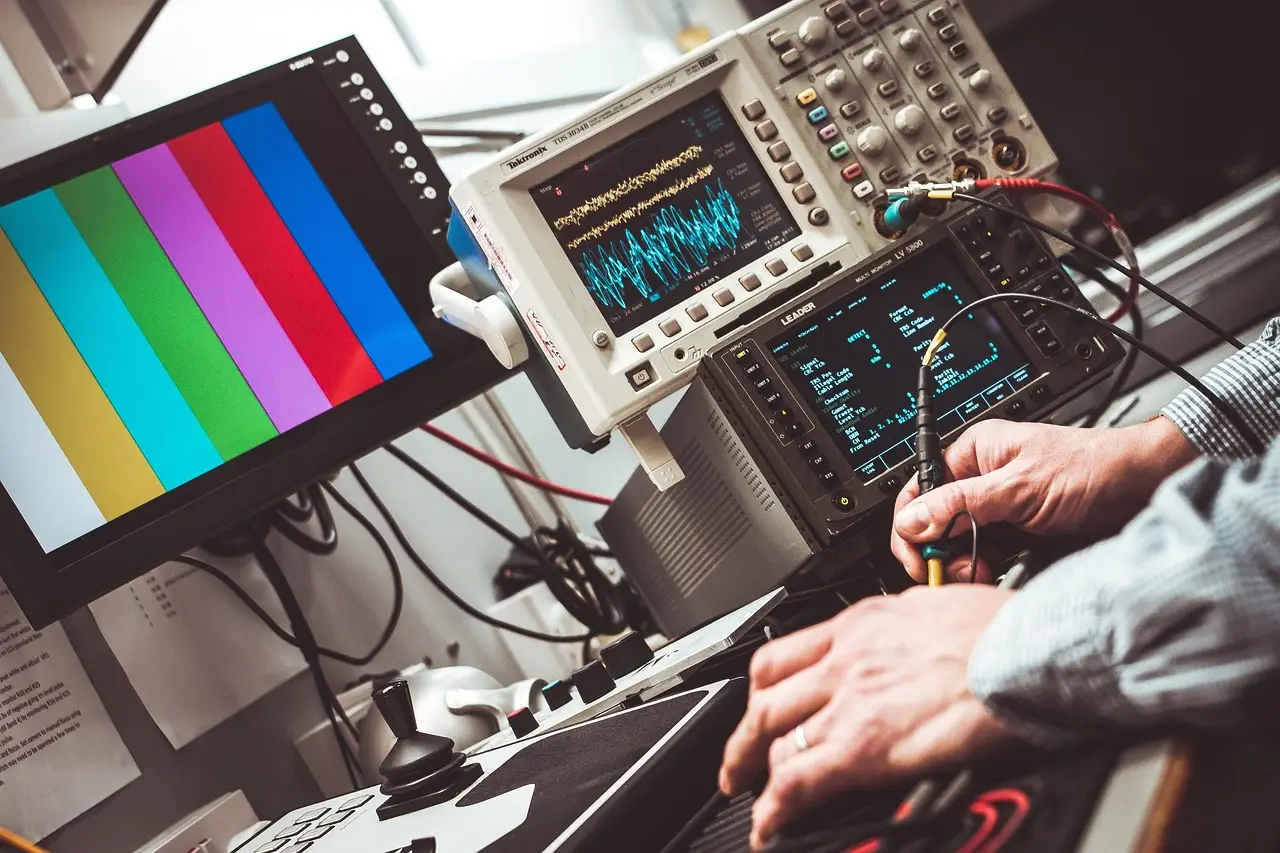
Emerson has built an AI assistant, Nigel, that generates LabVIEW code and test sequences from a plain prompt — and the company claims it debugs applications and speeds project review because it was custom-built for test, not adapted from a general chatbot. That's the claim. The evidence so far is a conversation, not a benchmark.
Alix Paultre, Editor-at-Large at Electronic Design, put the questions to Rudy Sengupta, Senior VP and CTO at Emerson, in a podcast covering the company's push into next-generation, AI-based test and development. Sengupta runs test and analytics software at Emerson's test and measurement business — the operation formerly known as NI — and is responsible, in his own portfolio language, for driving differentiation through software and recurring revenue growth. AI assistants fit that mandate neatly.
What does Nigel actually do?
According to Emerson, Nigel handles four concrete tasks:
- Generates code and test sequences from a prompt
- Debugs applications
- Reviews projects faster than manual inspection
- Answers technical questions about test applications
The differentiator, the company says, is context. Nigel has direct access to product documentation and receives the context of your project, so answers aren't generic. "They're specifically tailored for you," the company states. That distinction matters in test engineering, where an LLM guessing at an instrument's driver API is worse than no assistant at all.
No accuracy figures, latency numbers, or validated defect-detection rates appear in the source material. Buyers should treat the capability list as vendor claims until independent results exist.
Why build on industry models rather than from scratch?
Emerson says Nigel is built on the latest industry models, leveraging them to keep pace with rapidly evolving technology. The underlying logic is straightforward: foundation models improve on someone else's compute budget, and a domain layer — documentation, project context, test methodology — supplies the specificity that raw models lack. Emerson couples that layer with what it describes as the latest test methodologies, test system design, and data analysis.
For a metrology audience, the honest read is this: the physics of measurement hasn't changed. What's changed is the plumbing around it — code generation, debugging, and documentation retrieval. Takeaway: Nigel targets engineering hours, not measurement uncertainty.
Who is Rudy Sengupta?
Sengupta brings almost two decades at NI, across engineering, product management, and strategy, most recently as vice president of product management and software growth strategy. That role covered a broad portfolio: RF, precision and conditioned measurement, communication and data-acquisition hardware, plus application software.
He holds a Bachelor's degree in electrical and computer engineering from The University of Texas at Austin, with a technical focus on embedded systems and communication networks, and still serves on the university's Electrical Engineering Advisor Board. His background spans both sides of the stack Nigel is meant to serve — the measurement hardware and the software that orchestrates it.
What problem is this solving?
Emerson's framing of the pain is blunt: product engineering, development, and validation are plagued by disconnected tools and manual processes. Anyone who has stitched a rack of instruments, a test executive, and a spreadsheet-based calibration schedule together knows the diagnosis is fair.
The podcast's show notes sketch the scope of the discussion:
- 00:37 — Emerson's Nigel
- 02:08 — Generating code in LabVIEW
- 03:15 — Challenges for testing engineering
- 07:29 — Comprehensive approach to AI
LabVIEW code generation is the segment most likely to draw a crowd. Graphical dataflow programming was supposed to be the approachable one; now a prompt replaces the palette-diving. Progress, of a kind.
Should test teams adopt an AI in the loop?
The question the podcast raises — and doesn't fully answer — is verification. If Nigel writes your test sequence, who validates the sequence? A generated VI that passes syntax checks but misses an edge case is a compliance problem, not just a convenience problem. Emerson positions Nigel as an efficiency tool within intelligent automation, which is a reasonable framing; it is not yet a validation story with published test conditions.
For teams already on NI hardware and LabVIEW toolchains, the barrier to trying Nigel is low and the workflow fit is obvious. For regulated environments — aerospace, medical, automotive homologation — adoption will hinge on documented evidence that AI-generated code meets the same review standards as human-written code.
Takeaway: the tool looks useful; the audit trail doesn't exist yet in public form.
via ni.com (Original)
Filed under
- labview
- ai-code-generation
- test-automation
- emerson
- graphical-programming
More from Amara Osei
Show full bio
Senior reporter covering people, launches and day-to-day practice in Instruments, test and measurement at Testbench Report.
89 articles