TB-9589 · REV E · Technical newsheet
Metrology & CalibrationDevice profile
Lunar Silicon Cavity: Dark Craters Could Host Ultrastable Lasers
NIST/JILA physicists propose a silicon optical cavity in a permanently shadowed lunar crater, passively cooled to 16 K, as the reference for ultrastable lasers enabling lunar navigation and extraterrestrial timekeeping.
By Amara Osei4 min read819 words
Features
- Permanently shadowed lunar craters at ~50 K, with passive radiative cooling to 16 K, would host a silicon optical cavity at silicon's zero thermal-expansion point.
- A laser locked to the cavity could serve as a GPS-like landing aid, anchor the first extraterrestrial optical atomic clock, and enable precision ranging for gravitational-wave detection.
- The proposal appears in PNAS (May 8, 2026); co-author Yiqi Ni projects a low-Earth-orbit demonstration within two years and lunar surface deployment in three to five.
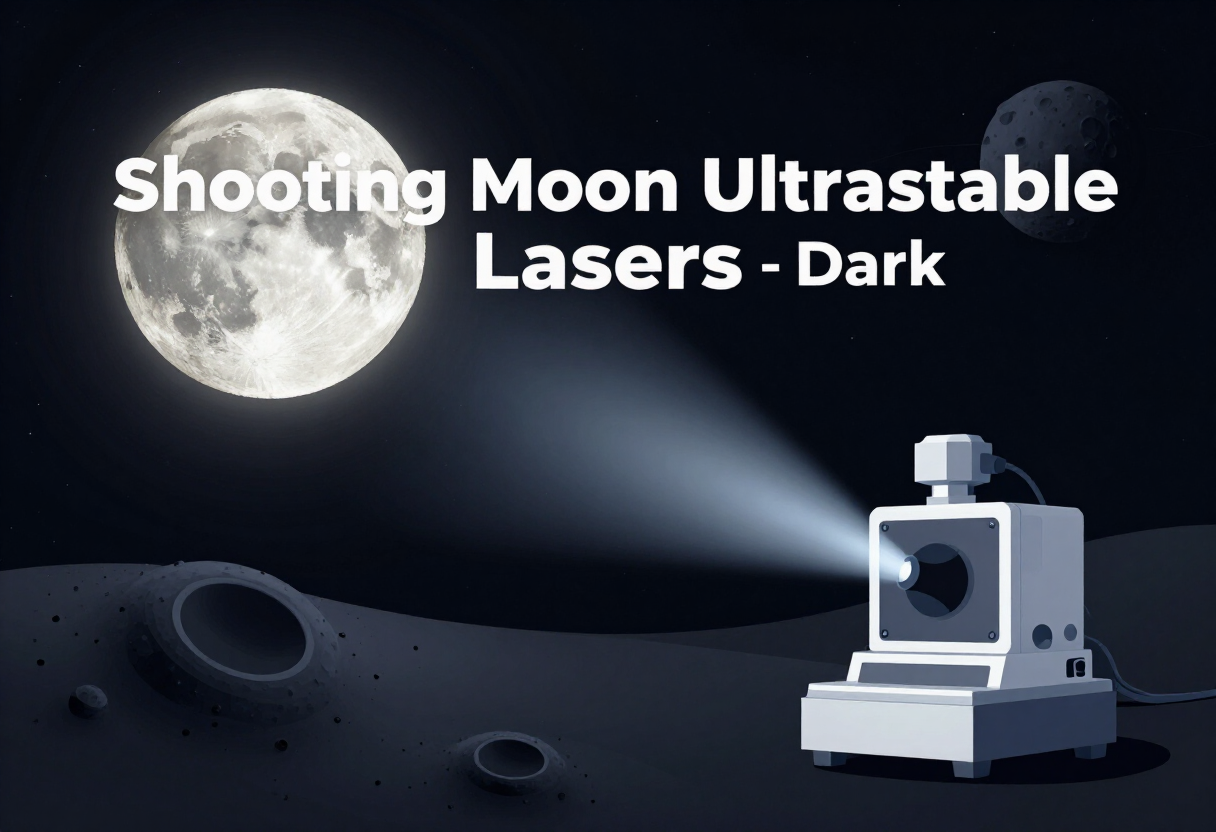
A laser locked to a silicon optical cavity cooled to 16 kelvin inside a permanently shadowed lunar crater could deliver frequency stability rivaling the best Earth-bound optical atomic clocks, according to a proposal published May 8, 2026, in the Proceedings of the National Academy of Sciences. Jun Ye of NIST and JILA and colleagues from NASA's Jet Propulsion Laboratory, the Physikalisch-Technische Bundesanstalt (PTB), and Lunetronic Inc. argue that the Moon's south polar craters offer an environment no terrestrial laboratory can match: temperatures near 50 K, no atmosphere, and minimal seismic vibration.
The instrument at the heart of the proposal is an optical silicon cavity — a silicon block with mirrors on each end that permits only certain frequencies of light to resonate. The mirror spacing sets the resonant frequencies, so any drift in that spacing translates directly into frequency drift of a laser locked to the cavity. That is the physics that makes thermal stability the binding constraint: below approximately 16 K, silicon's coefficient of thermal expansion crosses zero, so small temperature excursions neither expand nor contract the cavity, and light traverses an unchanged optical path length.
The lunar environment attacks the three noise sources that limit cavity performance in terrestrial labs. First, the Moon lacks air, so the cavity sits in high vacuum without the cryostat or vacuum hardware a lab on Earth requires. Second, permanently shadowed craters hold a temperature of roughly 50 K — about 223 °C — which sharply reduces Brownian motion of the mirror surfaces, the random jitter that sets the thermal noise floor. Third, the crater interior has a better vacuum than the open lunar surface, further suppressing perturbations from residual gas and stray particles striking the mirrors. The team proposes radiating residual heat from the cavity into deep space to passively cool it from 50 K down to 16 K, the zero-expansion operating point — no cryostat required.
Deployment would begin with a commercially available laser placed on the crater rim or inside the shadowed region. A small fraction of its light feeds the cavity, and an electronic lock ties the laser frequency to one of the cavity's resonances, fixing its output to a single, unchanging color. At that point the laser becomes a reference oscillator. Tuned to atomic clock signals on satellites, it could anchor the first optical atomic clock on an extraterrestrial surface, with a timekeeping signal that would rival the most precise optical clocks Ye's group has built in Colorado.
The navigation application is immediate. A stable laser signal could guide lunar spacecraft to safe landings, particularly in the dimly lit terrain near the south pole where visual navigation fails. A network of such lasers could measure inter-object distances on the Moon with high precision — and those baselines turn the Moon itself into a gravitational-wave detector. Passing space-time ripples would jostle the Moon and alter, ever so slightly, the distances between laser stations.
The engineering plan stays deliberately conservative. Study co-author Wei Zhang of JPL says the cavity is small enough to fit inside an Artemis spacecraft and would be fully assembled on Earth; only its radiation panels need to unfold during deployment. Astronauts would use a remote or mechanically controlled rover to lower the cavity into the crater, keeping human exposure to the shadowed terrain to a minimum.
Ye credits the idea to discussions about Artemis instrument payloads, some of which struck him as impractical or dependent on technology not yet mature on Earth. "I thought, 'let me throw out another crazy idea' — except it turned out to be not so crazy after all," he said. After years building silicon resonant cavities at JILA and PTB, "we know exactly what the key ingredients are," he added. "As soon as I understood what the permanently shadowed regions can offer, I felt that this would be the most ideal environment for a super-stable laser."
Co-author Yiqi Ni of Lunetronic notes the counterintuitive siting logic: poor illumination makes the polar regions hard to land in, yet those same permanently shadowed areas hold the water ice and other resources that sustain a long-term human presence, so precision navigation there is not optional. Ni estimates a silicon optical cavity could be demonstrated in low-Earth orbit within two years, deployed on the lunar surface within three to five, and eventually installed in a dark crater through multiagency coordination.
These are schedule projections, not measured results — no cavity has yet flown. What the paper does establish is that the thermal and vacuum conditions the design depends on are available for free at the lunar south pole, and that NASA has already designated regions near these craters as Artemis landing sites. The open question for agencies drafting lunar infrastructure standards: will the first extraterrestrial time and frequency reference be an optical signal locked to a silicon cavity at 16 K, and who calibrates it?
via pnas.org (Original)
Filed under
- optical-cavity
- silicon-cavity
- lunar-instrumentation
- atomic-clock
- frequency-reference
More from Amara Osei
Show full bio
Senior reporter covering industry trends and analytics at Testbench Report.
22 articles
Application notes
- NIST Builds 'Any Wavelength' Photonic Chip with 10,000 Circuits
- Off-the-Shelf Thermal Cameras Reconstruct Full-Aperture Wavefront Errors
- NIST Team Controls Molecular Ion Rotation with 99.8% Fidelity
- NIST Pins Down Martian Time: Clocks Run 477 µs Fast per Day
- Thermally 'Cooked' Fiber Nearly Doubles Low-Noise Supercontinuum Range