TB-2842 · REV D · Technical newsheet
Industrial IoT & MonitoringDevice profile
Universal Robots' Gen 7 Puts Ethernet, Power and Compute at the Tool Flange
Gen 7 puts Ethernet, power and configurable I/O at the tool flange, 40% more controller compute, and ROS 2 in PolyScope X — aimed squarely at physical AI on the factory floor.
By Olivia Hart4 min read722 words
Features
- Tool flange provides Ethernet, power and configurable I/O directly at the end-of-arm tooling
- CB7 Core controller delivers 40% more compute in a smaller footprint, with three 1-Gb Ethernet ports
- Three new arms — UR10g-1750, UR17g-1300, UR18g-950 — now encode payload and reach in the part number
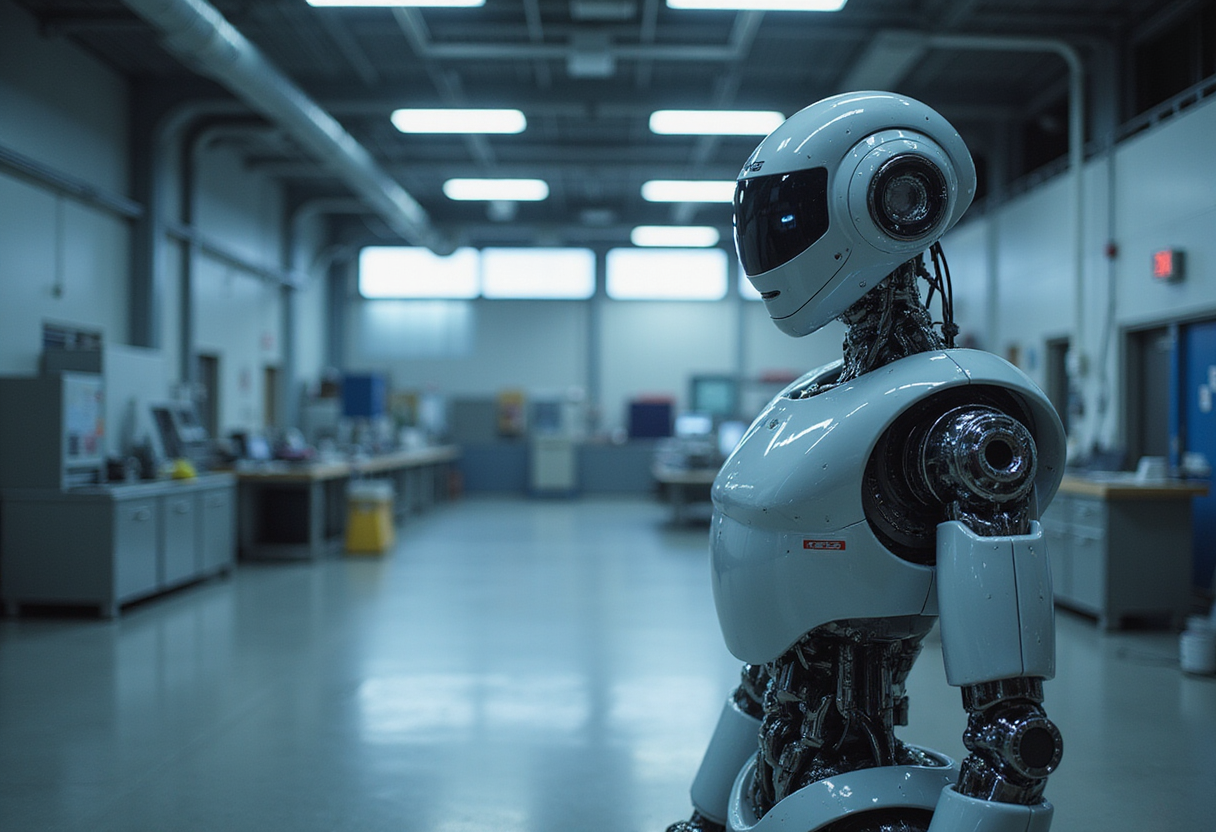
Universal Robots (UR) launched its seventh-generation collaborative robot platform on Sept. 14 at IMTS 2026 in Chicago, and the headline specification sits at the wrist: the new tool flange carries Ethernet, power and configurable I/O directly to end-of-arm tooling, so cameras and high-bandwidth sensors connect at the point of operation rather than through external cable runs.
Gen 7 comprises three g-Series arms, the CB7 Core controller, the TP7 Core teach pendant, the SP7 Smart Panel and PolyScope X software. The three arms — the UR10g-1750, UR17g-1300 and UR18g-950 — now encode both payload and reach in the part number, replacing the payload-only nomenclature of earlier UR models.
The renaming answers a direct customer request. "They said, 'For the love, put the reach in the part number,'" said Will Healy III, Director of Product & Industry Marketing at Teradyne Robotics, UR's parent. "If you know robotics, there's the holy triumvirate of robotics... reach, speed and payload. Putting payload and reach into our part numbers was important for customers."
Connectivity replaces isolation
The platform reflects a reversal of long-standing factory practice. "In the past, the general rule of thumb was, 'Don't put your automation on your network,'" Healy reminded the launch audience. AI applications demand communication between robots, cameras, computing resources and factory systems, so UR designed Gen 7 to operate inside the enterprise IT infrastructure rather than as an isolated OT island.
"If we're going to be a place where people land our AI, we need to be a modern and mature IT partner for the IT department," he said. "It's no longer OT versus IT. We're all part of the IT infrastructure."
The CB7 Core controller backs that position with hardware. UR claims it delivers 40% more compute power in a smaller footprint than the previous generation, and it provides three 1-Gb Ethernet ports plus configurable I/O for direct communication with PLCs, HMIs, MES platforms, industrial PCs and vision systems. Note that the 40% figure is a vendor claim; UR did not publish the test conditions at the launch.
At the arm itself, UR has integrated force-torque sensing, impedance control and RTDE (Real-Time Data Exchange) capabilities, aimed at dexterous manipulation and force-sensitive assembly. "The devices at the end of the robot are having to be much smarter," Healy said.
Christopher Savoia, Global Head of UR+ Ecosystem, framed the integration problem bluntly: "Naked robots don't do anything." The higher-power tool connection and integrated Ethernet are intended to cut cabling and simplify integration for vision, gripping, welding, inspection and material-handling partners.
Software as platform layer
PolyScope X supplies the software foundation, with an open API and built-in ROS 2 communication. Together, these interfaces let developers attach external AI processing and industrial computing to the robot without leaving the native environment. Savoia said Gen 7 remains compatible with existing UR+ technologies, which spares manufacturers from rebuilding their automation architecture each time a new AI-enabled tool arrives.
Usability numbers
The TP7 Core teach pendant, redesigned around ergonomics, weighs more than 20% less than previous generations and adds configurable buttons and a virtual joystick, according to UR. The SP7 Smart Panel moves robot controls and maneuvering functions closer to the application.
Healy positioned the platform for manufacturers who are not yet running AI. The architecture lets a workcell become "AI ready" — supporting future applications without replacing the underlying automation platform. He told the press that Gen 7 builds on more than 20 years of development and more than 100,000 deployments, drawing on customer feedback as AI moves from experiments into production.
UR demonstrated Gen 7 at more than 20 partner booths at IMTS, including Cognex, Schunk, Magswitch, Smooth Robotics, Psyonic, Robotiq and Inbolt — a measure of how quickly the ecosystem has ported onto the new connectivity.
Keith Fox, Vice President of Product Management at Universal Robots, framed the purchase decision: "Manufacturers are no longer asking whether Physical AI will matter. They're asking how to deploy it safely, reliably and at scale."
The open question for buyers: does a robot platform that joins the enterprise network — three 1-Gb ports, Ethernet at the flange, ROS 2 middleware — meet your cybersecurity and functional-safety requirements before the first AI workload lands on it?
via universal-robots.com (Original)
Filed under
- collaborative-robots
- universal-robots
- robot-connectivity
- machine-vision-integration
- physical-ai
More from Olivia Hart
Show full bio
Market editor covering media and advertising at Testbench Report.
33 articles
Application notes
- Physical AI's Missing Verb: Why 'Verify' Belongs in the Definition
- LMI Technologies Adds 2D Smart Cameras to Gocator Line
- Cisco Survey: 97% of Industrial Leaders See AI Reshaping Network Requirements
- Petro-SIM 7.7 Pairs First-Principles Simulation With Embedded ML
- Marposs Signs Partnership With TITANS of CNC at IMTS 2026