TB-5403 · REV A · Technical newsheet
Design EngineeringDevice profile
NIST Whisks Alloys With Looping Laser Paths in Metal 3D Printing
NIST used loop-the-loop laser paths to stir melt pools in powder bed fusion, mixing RHEA-19 and titanium into one alloy and verifying it with APS synchrotron X-rays.
By Amara Osei4 min read815 words
Features
- NIST mixed dense RHEA-19 with a titanium alloy using elliptical laser scanning in laser powder bed fusion, with no new hardware required.
- The team verified atomic-level mixing in real time using X-ray diffraction at Argonne's Advanced Photon Source, whose beams are roughly 500 billion times brighter than dental X-rays.
- Paper: Yeung et al., 'Laser stirring with elliptical scanning enables on-demand alloying in additive manufacturing,' Additive Manufacturing, published online Jan. 30, 2026, DOI: 10.1016/j.addma.2026.105101.
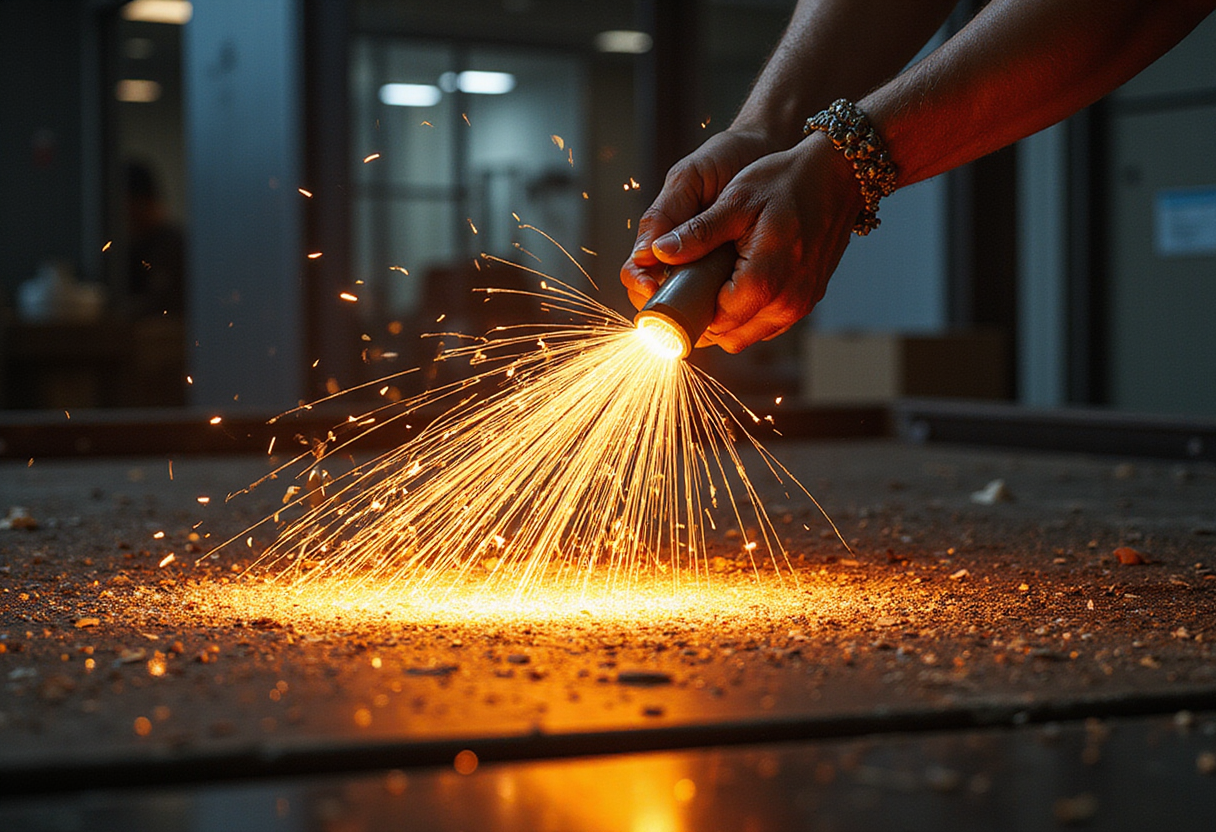
Researchers at the National Institute of Standards and Technology (NIST) have demonstrated that a laser powder bed fusion printer can mix dissimilar metals down to the atomic level — the requirement for high-entropy alloys (HEAs) — simply by changing the laser's scan path from straight lines to loop-the-loops. No new hardware is required. The team verified the result in real time with X-ray diffraction at the Advanced Photon Source (APS) at Argonne National Laboratory, watching the alloy's atomic structure as the melt pool solidified in less than a second.
The work, published in Additive Manufacturing on Jan. 30, 2026 (DOI: 10.1016/j.addma.2026.105101), addresses a specific metallurgical constraint. High-entropy alloys — a class developed over the past 20 years — contain multiple metals in roughly equal proportions; an HEA might consist of 20% each of five elements. That composition is what gives HEAs their strength at high temperatures, a property relevant to jet engines and nuclear reactors. But equal proportions are exactly what makes them hard to produce.
"HEAs need to be mixed down to the atomic level," said Fan Zhang, the NIST physicist who co-led the project. "It takes extra effort to get metals to blend together in those ratios."
The physics problem is segregation. Different metals differ in density, melting point and surface tension, so as a molten pool cools, the components separate into distinct regions — like oil and water — and the resulting patchwork weakens the part. Conventional steel avoids this because it is mostly iron with small additions of carbon or other elements; the near-single-element base makes mixing tractable. Casting an HEA, by contrast, tends to leave those blotches behind.
"It's difficult to make HEA parts with traditional methods like casting," said Zhang. "But we believe metal 3D printing could be a solution."
In laser powder bed fusion, a laser traces a pattern across a layer of fine powder, melting a puddle smaller than a ladybug's eye for a fraction of a second. Heat alone stirs the metals slightly within that puddle, but not enough for an HEA. NIST researcher Ho Yeung's solution: direct the laser to draw loop-the-loops as it advances, actively stirring the melt pool during fusion.
The software was the hard part. "Commercial 3D printer software can't make these patterns," Yeung explained. "They are very limited in how the laser's path can be adjusted, so we had to write the software from scratch." Because the technique needs no major new components, existing metal 3D printers could in principle be reprogrammed to use it.
The measurement challenge
Proving atomic-level mixing required watching solidification in real time — a demanding measurement because the metals are dense and the liquid-to-solid transition completes in under a second. The team partnered with the APS, a ring-shaped synchrotron larger than a football stadium whose X-ray beams are roughly 500 billion times brighter than a dental X-ray source. As the beam passed through the solidifying metal, photons deflected off the atoms and formed a diffraction pattern that the researchers decoded to track atomic arrangement frame by frame. Electron microscopy of the finished, fully solid parts confirmed the result.
"The APS is one of the few photon sources in the world powerful enough to allow us to perform this type of measurement," said Zhang.
The stress test combined two materials that normally resist mixing: RHEA-19, a dense refractory high-entropy alloy, and a lightweight titanium alloy. The team laid the powders side by side, ran the looping laser across the boundary, and confirmed with the synchrotron and microscope data that the metals had formed a genuinely blended alloy rather than adjacent regions.
Why it matters for process economics
Today, metal powder bed fusion binds you to one alloy per powder. Printing a dozen alloys means stocking a dozen pre-alloyed powders. The laser-stirring method points toward the office-printer model: keep a small set of elemental powders on hand and form the alloy inside the printer, on demand. Yeung and colleagues also note the technique could grade composition continuously through a part — a jet turbine blade printed from several metals without the weld joints that create weak spots.
"We want to accelerate alloy making," said Yeung. "Metal 3D printing has the potential to make parts that used to be impossible."
Note that the reported verification covers one material pair under synchrotron observation; the broader claim — that the method generalizes to arbitrary alloy combinations and graded parts — remains a research direction, not a demonstrated production capability. The adoption question for machine builders and powder suppliers is whether scan-path control at this level becomes a standard feature of printer software, or whether it stays in the realm of custom, lab-written toolchains while the qualified-powder ecosystem continues to dominate certified aerospace and medical workflows.
via aps.anl.gov (Original)
Filed under
- metal-3d-printing
- high-entropy-alloys
- laser-powder-bed-fusion
- nist
- x-ray-diffraction
More from Amara Osei
Show full bio
Senior reporter covering industry trends and analytics at Testbench Report.
22 articles
Application notes
- NIST Builds 'Any Wavelength' Photonic Chip with 10,000 Circuits
- NIST Report Maps Strategy for Sustainable U.S. Metals Infrastructure
- Machine Vision System Targets Micro-Defects in 3D-Printed Parts
- Thermally 'Cooked' Fiber Nearly Doubles Low-Noise Supercontinuum Range
- Tolerance-Driven Scanning, Record Renishaw Revenue Lead Metrology Week