Technical newsheet
Machine Vision & InspectionDevice profile
DEEPX runs YOLO26 on four video streams on one RK3588 board
DEEPX's open-source demos run YOLO26 detection and segmentation on four video streams at once on an RK3588 board, splitting decode, preprocessing, inference and compositing across VPU, RGA, NPU and Mali GPU — with no OpenCV.
By Olivia Hart4 min read751 words
Features
- Two open-source Qt demos run YOLO26n and YOLO26n-seg on 4 simultaneous video streams in a 2x2 grid
- All processing is hardware-accelerated on RK3588: VPU decode, RGA preprocess, DEEPX DX-M1 NPU inference, Mali GPU compositing
- Built entirely on DX-STREAM native GStreamer plugins with pydxs bindings — no OpenCV dependency
- sync_to_fps can be disabled for maximum-throughput testing; detection boxes are read before RGA downscaling for accuracy
- Runs on Orange Pi 5 Plus / ROCK Pi; inputs support video files, RTSP URLs and cameras up to 4 channels
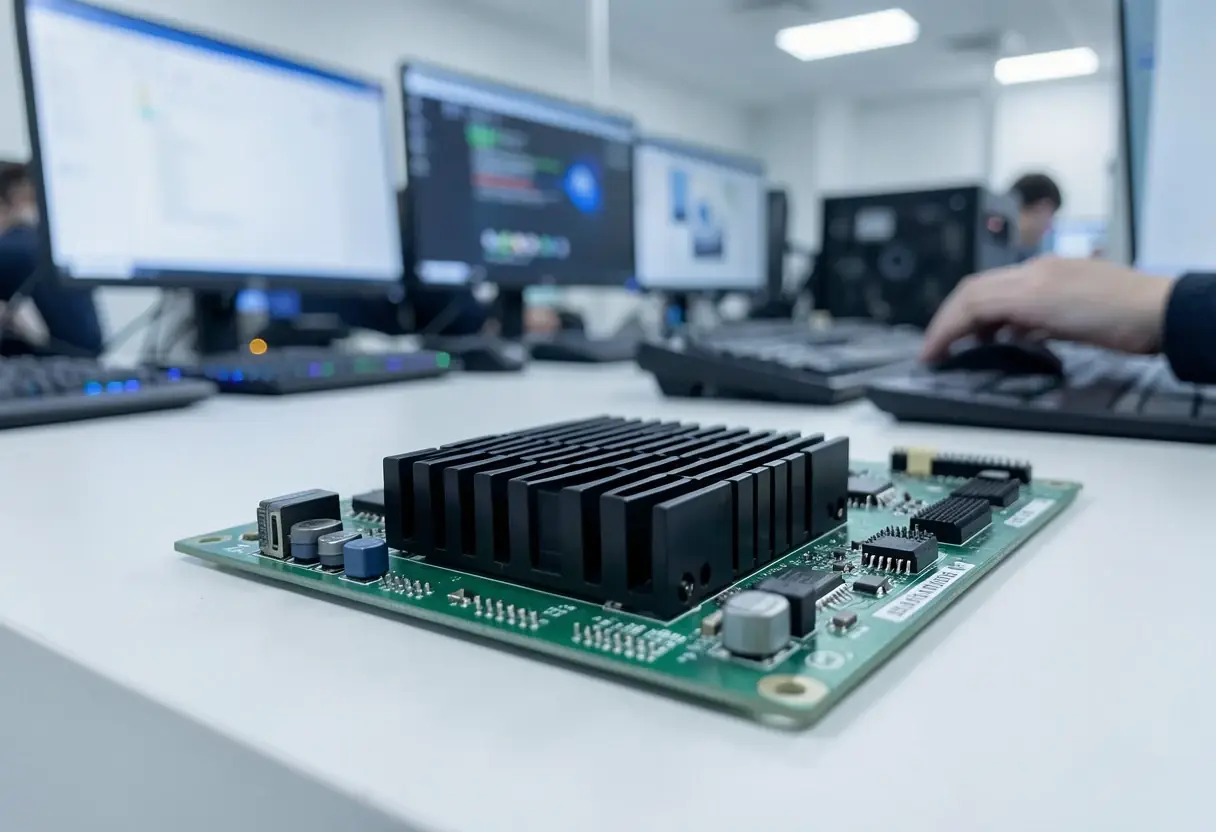
Four concurrent YOLO26 pipelines, one RK3588 board, no OpenCV anywhere in the stack. DEEPX has published two open-source Qt applications that run object detection and instance segmentation on four video streams simultaneously, displaying the results in a 2x2 grid on a single monitor, with every stage of each pipeline assigned to dedicated silicon on Rockchip's flagship SoC.
The two demos, released in the DEEPX-AI dx_demo repository on GitHub, differ only in their model and overlay. The detection variant runs YOLO26n (the "n" denoting the nano-sized model in Ultralytics' naming) and draws bounding boxes, with a class panel on the right side of the window toggling boxes per class on or off. The segmentation variant runs YOLO26n-seg and draws instance masks. According to the vendor's write-up on the DEEPX Developer Community forum, the masks are rendered in hardware.
Which hardware block does what?
The architecture is the story here. Each of the four channels runs its own independent GStreamer pipeline, and the work is partitioned across five hardware units on the RK3588 (Rockchip's octa-core SoC found in boards such as the Orange Pi 5 Plus and ROCK Pi):
- Video decode: the VPU (Video Processing Unit, the fixed-function decoder)
- Preprocessing — letterbox and resize: the RGA (Rockchip's 2D raster graphic acceleration engine)
- Inference: the DEEPX DX-M1 NPU (a neural processing unit mounted on the board as a co-processor)
- Display downscale and color conversion: RGA again
- 2x2 tile compositing: the Mali GPU
Nothing touches the CPU for pixel work. The demos are built entirely on DX-STREAM, DEEPX's native GStreamer plugin suite, with Python bindings called pydxs sitting on top of the DX-RT runtime. The GUI is PySide6 (Qt for Python). The absence of OpenCV is deliberate: GStreamer talks to the RK3588's media hardware directly, avoiding a CPU-side format conversion that a cv2-based pipeline would typically pay for.
Inputs are video files by default, but each channel can be configured as a video file, an RTSP URL, or a camera index, up to four channels total, by editing the channels list under demo/config/.
What about throughput and 4K?
Two design details matter to anyone benchmarking edge-AI vision systems. First, native-FPS playback: each channel plays at its source video's frame rate, so the decoder and NPU do only real-time work rather than racing ahead. The developers note that turning sync_to_fps off converts the demo into a flat-out throughput test — a useful switch when you want the maximum frames-per-second number the DX-M1 can sustain on four streams rather than a wall-clock-realistic one. The source does not publish that maximum figure; anyone evaluating the board will have to measure it.
Second, the 4K path. Frames are downscaled on the RGA before they reach Qt, so the GUI's rendering cost stays the same whether the inputs are FHD or 4K. Crucially for measurement integrity, detections are read out before downscaling, so bounding-box coordinates keep full-resolution accuracy rather than inheriting the display scale's rounding.
How to reproduce it
The entry barrier is one script. After cloning the repository:
git clone https://github.com/DEEPX-AI/dx_demo.git
cd dx_demo/yolo26_4ch_demo        # or yolo26seg_4ch_demo
./run_demo.sh
The script sets up the environment, downloads the models and sample videos if missing, and starts the demo. A separate install.sh can install the NPU driver, runtime, firmware, and DX-STREAM itself on boards that lack them.
The release is also an implicit argument about system partitioning. The RK3588 has no single accelerator fast enough to do everything, so the demos treat the SoC as a small heterogeneous compute farm: fixed-function decode, a 2D blitter for geometry and color, an external NPU for the neural network, and the GPU only for final compositing. That division of labor — not raw NPU throughput — is what makes four simultaneous streams fit on a fanless-class single-board computer.
The open question the release raises for integrators: does this partitioning transfer? The demos are tuned to Rockchip's specific block inventory. Anyone deploying on a different SoC — an NXP i.MX, a Qualcomm RB-series, an NVIDIA Jetson — will have to redraw the map of which unit handles decode, preprocess, inference and compositing. DEEPX explicitly invites exactly that: the project's closing note asks developers who have built pipelines on other boards to share, in the comments, how they split the work across their hardware.
via hackster.io (Source)
Filed under
More from Olivia Hart
Show full bio
Market editor covering technology and product news in Instruments, test and measurement at Testbench Report.
106 articles
Application notes
- DEEPX Demo Runs YOLO Object Detection on 100 Video Channels
- Cognex Bolts Nvidia Jetson Onto the In-Sight 6900 for Edge AI Inspection
- Cognex Brings Nvidia Jetson Compute Into Its Machine Vision Line
- Quality Magazine: Machine Vision Moves to On-Camera Inference
- IDS GMSL2 Discovery Kit Pairs Jetson Orin NX with Synced Multi-Camera Vision