TB-3085 · REV A · Technical newsheet
Industrial IoT & MonitoringDevice profile
Edge Autoencoder Detects Motor Faults on 20 kHz Vibration Data
A convolutional autoencoder trained only on healthy vibration data catches imbalance, misalignment and bearing defects at the edge, cutting bandwidth and extending battery life.
By Sophie Lindqvist3 min read665 words
Features
- Voyager4 samples three-axis vibration data at 20 kHz for edge-based motor fault detection
- The autoencoder input is a 2D tensor of shape (256, 3); output is a 1D tensor of length 768
- Model was validated against 10 healthy operating modes and 120 fault modalities
- The network runs on a MAX78000 microcontroller, sized for edge memory and compute limits
- Dataset and pre-processing guidelines are publicly available on GitHub
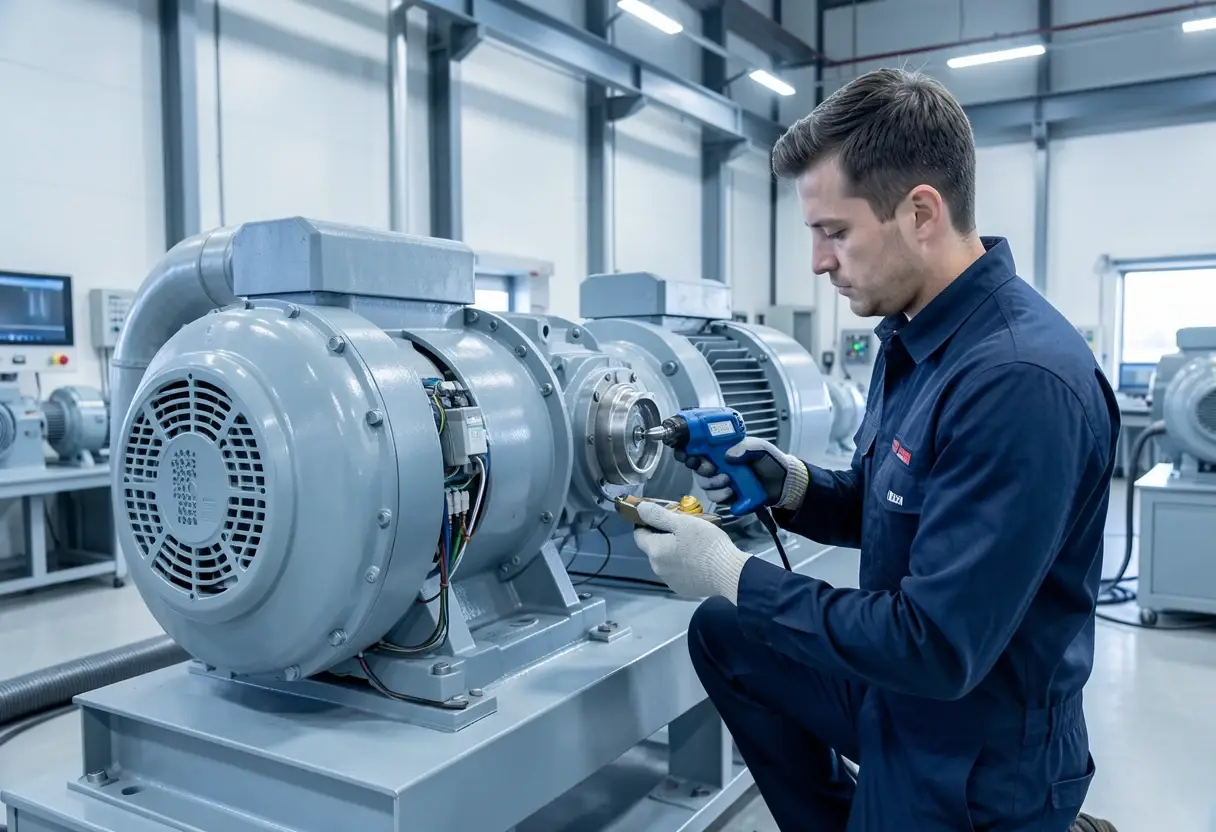
Three-axis vibration data sampled at 20 kHz is enough for a neural network running on a microcontroller to flag motor imbalance, misalignment and bearing defects — without a single labeled fault example. That's the result Analog Devices reports from an edge AI implementation on its Voyager4 wireless condition-monitoring platform, with the model deployed on a MAX78000 microcontroller.
Why push inference to the sensor? Conventional condition monitoring streams raw sensor data to a gateway or the cloud, and that centralization taxes network bandwidth, latency and power. For battery-operated wireless sensors bolted onto pumps, automation motors or power turbines, those constraints decide whether a deployment scales at all. Local inference trims the communication overhead, so the authors — systems applications engineers Richard Anslow and Tom Sharkey — argue the approach cuts latency and stretches battery life while keeping fault detection reliable.
What does the vibration signature tell you?
The physics is straightforward. A healthy motor produces a characteristic vibration spectrum; faults introduce deviations. Mechanical imbalance between rotors raises the amplitude at the motor's drive frequency. Misalignment adds harmonics. Bearing defects show up as high-frequency spikes. Sampling at 20 kHz across X, Y and Z axes captures both the low- and high-frequency components of those signatures.
Pre-processing segments the signal into fixed-length windows, normalizes it, and formats it into tensors for training and inference. The authors note there's no universal recipe here — fast Fourier transform isn't the only feature-extraction option, but it tended to deliver better accuracy in their evaluation.
How does the autoencoder work?
The core of the system is an autoencoder (a neural network trained to compress and then reconstruct its own input) trained exclusively on healthy motor data. It learns to rebuild normal vibration patterns with high fidelity; when faulty data arrives, the reconstruction error climbs, and that error becomes the anomaly metric. Because the method needs no labeled fault data, it fits industrial settings where fault examples are scarce.
The architecture has practical fingerprints. Input is a 2D tensor of shape (256, 3) — 256 channels of width 3, each channel holding one frequency-bin value per vibration axis. CNN filters work depth-wise, so at the input layer each filter sees a single axis at a time; the model combines axes internally. The output is a 1D tensor of length 768 (three axes × 256 frequency bins), because the output layer is fully connected rather than convolutional.
That choice is a workaround, not a preference: 1D transpose convolutions aren't yet available in the target software stack, and transpose convolutions are what you'd normally use in the decoder to reconstruct the compressed representation. Convolutional layers still handle the encoder, keeping total parameter count down — a real constraint when the model must fit the MAX78000's memory and compute budget.
How accurate is it?
The only loss function is mean squared difference between output and input — the reconstruction error. The evaluation dataset spanned 10 healthy operating modes and 120 fault modalities. The authors make a practical point: the fewer healthy modes the model must classify as healthy, the easier the learning task, and the less overlap between high reconstruction errors on healthy samples and low errors on faulty ones. Overlap in the histograms is exactly where false positives and false negatives live.
The decision threshold sets the acceptable error trade for the application. A critical motor in a key industrial process, for instance, would get a low threshold to suppress false negatives — missed faults — at the cost of more alarms. The full dataset, plus data-loading and pre-processing guidelines, is available on GitHub.
The takeaway for practitioners: unsupervised reconstruction-error detection, sized for a microcontroller, is now a documented, reproducible pipeline rather than a lab demo. The open question for adoption is whether maintenance teams will trust a threshold-tuned anomaly score in place of expert spectral analysis — and how they'll validate it against their own rotating machinery before it gates a shutdown decision.
via analog.com (Original)
Filed under
- condition-monitoring
- edge-ai
- motor-fault-detection
- vibration-analysis
- autoencoders
More from Sophie Lindqvist
Show full bio
News editor covering regulation, policy and their impact on Instruments, test and measurement at Testbench Report.
110 articles
Application notes
- IMI to supply wireless vibration monitoring in Oman
- Wireless Vibration Sensors and Machine Learning Reshape Pump Health Monitoring
- STMicroelectronics Puts Neural-Network Inference On-Chip in Industrial Vibration Sensor
- ST Sensor Moves AI Into Industrial Vibration Monitoring
- DLR Publishes Holistic Condition Monitoring Framework for Predictive Maintenance