TB-5587 · REV C · Technical newsheet
Metrology & CalibrationDevice profile
NIST Pins Down Martian Time: Clocks Run 477 µs Fast per Day
NIST's Patla and Ashby calculate that Mars clocks gain 477 µs/day over Earth time, varying ±226 µs across the Martian year — the first quantified Martian clock rate.
By Nathan Brooks4 min read793 words
Features
- Clocks on Mars tick 477 microseconds per day faster than on Earth, varying by up to 226 µs/day over the Martian year
- Lunar time runs a constant 56 µs/day faster than Earth time; the Moon/Mars paper follows NIST's 2024 lunar timekeeping plan
- Published Dec. 1, 2025 in The Astronomical Journal, DOI: 10.3847/1538-3881/ae0c16
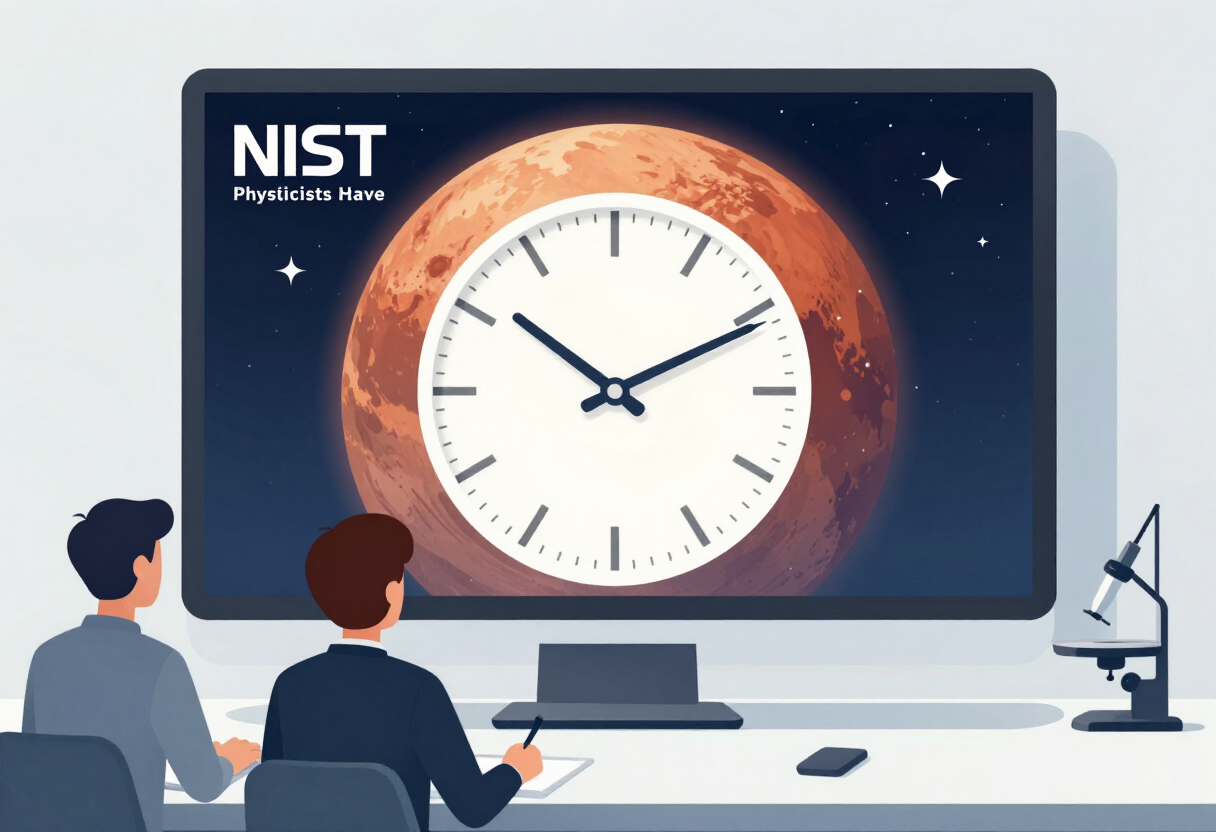
NIST physicists Bijunath Patla and Neil Ashby have published the first precise calculation of how time on Mars diverges from terrestrial time: on average, a clock on the Martian surface ticks 477 microseconds per day faster than its counterpart on Earth. The offset is not constant. Mars' eccentric orbit and the gravitational pull of its planetary neighbors modulate the rate by as much as ±226 microseconds per day over the course of the 687-day Martian year.
The paper, "A Comparative Study of Time on Mars with Lunar and Terrestrial Clocks," appeared online in The Astronomical Journal on December 1, 2025 (DOI: 10.3847/1538-3881/ae0c16). It follows the same NIST group's 2024 work establishing a timekeeping plan for the Moon, where the relativistic offset is far better behaved: time on the lunar surface runs a consistent 56 microseconds per day ahead of Earth time.
The physics behind the number
Einstein's general relativity ties clock rate to gravitational potential: clocks tick slower where gravity is stronger and faster where it is weaker, and orbital velocity adds its own special-relativistic contribution. Surface gravity on Mars is roughly five times weaker than on Earth, so an atomic clock landed there runs at its nominal rate locally but drifts out of sync when compared against an identical clock on the geoid. NIST chose a reference point on the Martian surface — analogous to sea level at the equator on Earth — and used years of data from Mars missions to estimate local gravity.
That was the easy part. The Sun holds more than 99% of the solar system's mass, and Mars' distance from it, combined with perturbations from Earth, the Moon, Jupiter and Saturn, pulls the planet into an elongated, eccentric orbit. Earth's and the Moon's orbits are relatively constant, which is why the lunar offset holds steady at 56 microseconds. Mars does not enjoy that stability.
"For Mars, that's not the case. Its distance from the Sun and its eccentric orbit make the variations in time larger. A three-body problem is extremely complicated. Now we're dealing with four: the Sun, Earth, the Moon and Mars," Patla explained. "The heavy lifting was more challenging than I initially thought."
Why half a millisecond matters
A 477-microsecond daily drift sounds negligible — about a thousandth of the time it takes to blink. Modern communications infrastructure works to far tighter tolerances. Patla notes that 5G networks require timing accuracy within a tenth of a microsecond, three orders of magnitude finer than the Martian offset.
The practical context is stark. Signal propagation between Earth and Mars currently imposes delays of four to 24 minutes, sometimes more. Patla compares the situation to pre-telegram communication: letters carried across the ocean by ship, with weeks or months before a reply arrives. A rigorous relativistic timing framework between planets is the prerequisite for synchronized networks over interplanetary distances.
"If you get synchronization, it will be almost like real-time communication without any loss of information. You don't have to wait to see what happens," Patla said.
Metrology as mission preparation
Ashby cautions against expecting near-term deployment. Both the interplanetary networks and the long-duration human and robotic missions they would serve remain distant. "It may be decades before the surface of Mars is covered by the tracks of wandering rovers, but it is useful now to study the issues involved in establishing navigation systems on other planets and moons," he said. "Like current global navigation systems like GPS, these systems will depend on accurate clocks, and the effects on clock rates can be analyzed with the help of Einstein's general theory of relativity."
The work also carries metrological value independent of any mission. Nobody had previously quantified the Martian clock rate. "It's good to know for the first time what is happening on Mars timewise. Nobody knew that before. It improves our knowledge of the theory itself, the theory of how clocks tick and relativity," Patla said. "The passage of time is fundamental to the theory of relativity: how you realize it, how you calculate it, and what influences it. These may seem like simple concepts, but they can be quite complicated to calculate."
Patla sees the timing as opportune, with NASA planning Mars exploration missions that will require synchronized navigation and communication across the solar system. "The time is just right for the Moon and Mars," he said. "This is the closest we have been to realizing the science fiction vision of expanding across the solar system."
The question the paper leaves open for the community: who defines and operates a Martian coordinate time scale — and against which clock ensemble and relativity convention will future Mars navigation systems be calibrated?
via science.nasa.gov (Original)
Filed under
- atomic-clocks
- general-relativity
- mars-exploration
- time-synchronization
- nist
More from Nathan Brooks
Show full bio
Staff writer covering industry trends and analytics at Testbench Report.
19 articles
Application notes
- Lunar Silicon Cavity: Dark Craters Could Host Ultrastable Lasers
- NIST Builds 'Any Wavelength' Photonic Chip with 10,000 Circuits
- Tracing as a Firmware Oscilloscope for Zephyr RTOS Designs
- NIST RM 8043 Brings Degraded DNA and Mixtures to Forensic Labs
- NIST Team Controls Molecular Ion Rotation with 99.8% Fidelity